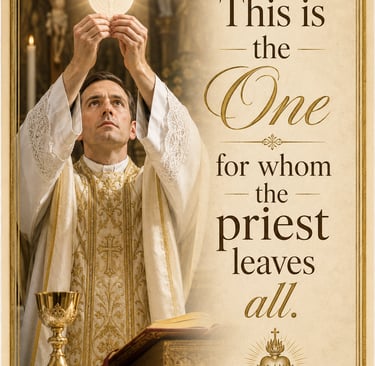
You, Catholic priests and bishops
are the most powerful men on earth.
No one has more power, not even the angels.
Shoot forth sparks of love for Jesus Eucharistic.
The people will love you, and they will love Who you love,
and that love, dear spiritual fathers of mankind, will save civilization.
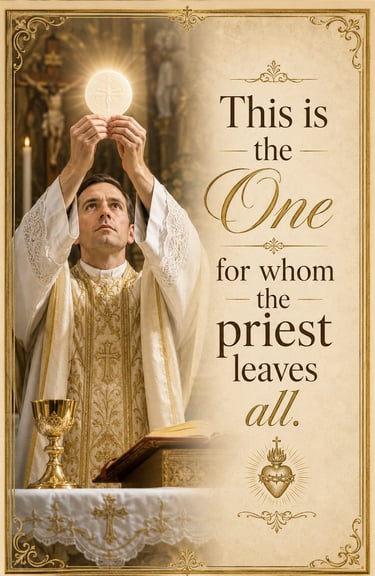
Only you can transform bread into the Living Bread: the living God, and you can, like no other man, forgive sins. And those of you who love God, specifically Our Eucharistic Lord, if you love Him and realize that in that small Host is all the power of God. He will empower you to save souls and, in these critical times, save civilization.
Saint Mother Teresa ".. ask your parish priest to have perpetual adoration in your parish. I beg the Blessed Mother to touch the hearts of all parish priests that they may have perpetual Eucharistic adoration in their parishes, and that it may spread throughout the entire world.
POPE SAINT JOHN PAUL II: "The best, the surest and the most effective way of establishing everlasting peace on the face of the earth is through the great power of Perpetual Adoration of the Blessed Sacrament."
Venerable Archbishop Fulton J. Sheen. “I am asking you, every single day of your life without any exception, to make a continuous hour of adoration in the Presence of Our Lord in the Blessed Sacrament…”
“Because we live in a demonic age, the time has come to take seriously this Holy Hour. It is the only thing our Blessed Lord ever asked us to do, ever asked directly of His disciples: ‘Can you not stay awake one hour with me?’”
“Who should make it [a Holy Hour of Eucharistic Adoration]? Bishops, for an apathetic world, so that during that Holy Hour the Blessed Lord will speak to them, as He spoke to Paul at Corinth. ‘Be courageous, be not silent, speak out, I am with you.’”
“Priests. Make the Holy Hour. It may be a sacramental sign of our victimhood. Would you have power in the pulpit? Would you be able to console the sick? Would you be able to make converts? Then spend the Hour with our Lord. When you mount the pulpit you will shoot forth sparks, and the people will love you.”
“Could You Not Watch One Hour with Me?” Why Make a Holy Hour?
Here are ten reasons.
1. It is time spent in the presence of Our Lord Himself. If faith is alive, no further reason is needed.
2. In our busy lives, it takes considerable time to shake off the “noonday devils,” the worldly cares, that cling to our souls like dust. An hour with Our Lord follows the experience of the disciples on the road to Emmaus (Luke 24:13–35). We begin by walking with Our Lord, but our eyes are “held fast” so that we do not “recognize him.” Next, He converses with our soul, as we read the Scriptures. The third stage is one of sweet intimacy, as when “he sat down at table with them.” The fourth stage is the full dawning of the mystery of the Eucharist. Our eyes are “opened,” and we recognize Him. Finally, we reach the point where we do not want to leave. The hour seemed so short. As we arise, we ask: “Were not our hearts burning within us when he spoke to us on the road, and when he made the Scriptures plain to us?” (Luke 24:32).
3. Our Lord asked for it. “Had you no strength, then, to watch with me even for an hour?” (see Matt. 26:40). The word was addressed to Peter, but he is referred to as Simon. It is our Simon nature that needs the hour. If the hour seems hard, it is because “the spirit is willing enough, but the flesh is weak” (Mark 14:38).
4. The Holy Hour keeps a balance between the spiritual and the practical. Western philosophies tend to an activism in which God does nothing, and man everything; the Eastern philosophies tend to a quietism in which God does everything, and man nothing. The golden mean is in the words of St. Thomas: “action following rest,” Martha walking with Mary. The Holy Hour unites the contemplative to the active life of the person. Thanks to the hour with Our Lord, our meditations and resolutions pass from the conscious to the subconscious and then become motives of action. A new spirit begins to pervade our work. The change is effected by Our Lord, who fills our heart and works through our hands. A person can give only what he possesses. To give Christ to others, one must possess Him.
5. The Holy Hour will make us practice what we preach. “Here is an image,” he said, “of the kingdom of heaven:
there was once a king, who held a marriage feast for his son and sent out his servants with a summons to all those whom he had invited to the wedding; but they would not come” (Matt. 22:2–3). It was written of Our Lord that He “began to do and to teach” (Acts 1:1). The person who practices the Holy Hour will find that when he teaches, the people will say of him as of the Lord: “All ... were astonished at the gracious words which came from his mouth” (Luke 4:22).
6. The Holy Hour helps us make reparation for the sins of the world and for our own sins. When the Sacred Heart appeared to St. Margaret Mary, it was His Heart, and not His head, that was crowned with thorns. It was Love that was hurt. Black Masses, sacrilegious communions, scandals, militant atheism—who will make up for them? Who will be an Abraham for Sodom, a Mary for those who have no wine? The sins of the world are our sins as ifwe had committed them. If they caused Our Lord a bloody sweat, to the point that He upbraided His disciples for failing to stay with Him an hour, shall we with Cain ask: “Is it for me to watch over my brother?” (Gen. 4:9).
7. It reduces our liability to temptation and weakness. Presenting ourselves before Our Lord in the Blessed Sacrament is like putting a tubercular patient in good air and sunlight. The virus of our sins cannot long exist in the face of the Light of the world. “Always I can keep the Lord within sight; always he is at my right hand, to make me stand firm” (Ps. 15:8). Our sinful impulses are prevented from arising through the barrier erected each day by the Holy Hour. Our will becomes disposed to goodness with little conscious effort on our part. Satan, the roaring lion, was not permitted to put forth his hand to touch righteous Job until he received permission (Job1:12). Certainly, then, will the Lord withhold serious fall from him who watches (1 Cor. 10:13). With full confidence in his Eucharistic Lord, the person will have a spiritual resiliency. He will bounce back quickly after a falling: “Fall I, it is but to rise again, sit I in darkness, the Lord will be my light. The Lord’s displeasure I must bear, I that have sinned against him, till at last, he admits my plea, and grants redress” (Micah 7:8–9). The Lord will be favorable even to the weakest of us, if He finds us at His feet in adoration, disposing ourselves to receive divine favors. No sooner had Saul of Tarsus, the persecutor, humbled himself before his Maker than God sent a special messenger to his relief, telling him that “even now he is at his prayers” (Acts 9:11). Even the person who has fallen can expect reassurance if he watches and prays. “They shall increase, that hitherto had dwindled, be exalted, that once were brought low” (Jer. 30:19).
8. The Holy Hour is a personal prayer. The person who limits himself strictly to his official obligation is like the union man who downs tools the moment the whistle blows. Love begins when duty finishes. It is a giving of the cloak when the coat is taken. It is walking the extra mile. “Answer shall come ere cry for help is uttered; prayer find audience while it is yet on their lips” (Isa. 65:24). Of course, we do not have to make a Holy Hour—and that is just the point. Love is never compelled, except in hell. There love has to submit to justice. To be forced to love would be a kind of hell. No man who loves a woman is obligated to give her an engagement ring, and no person
who loves the Sacred Heart ever has to give an engagement Hour. “Would you, too, go away?” (John 6:68) is weak love; “Art thou sleeping?” (Mark 14:37) is irresponsible love; “He had great possessions” (Matt. 19:22; Mark 10:22) is selfish love. But does the person who loves His Lord have time for other activities before he performs acts of love “above and beyond the call of duty”? Does the patient love the physician who charges for every call, or does he begin to love when the physician says: “I just dropped by to see how you were”?
9. Meditation keeps us from seeking an external escape from our worries and miseries. When difficulties arise, when nerves are made taut by false accusations, there is always a danger that we may look outwards, as the Israelites did, for release... From the Lord God, the Holy One of Israel, word was given you: “Come back and keep still, and all shall be well with you; in quietness and in confidence lies your strength. But you would have none of it; To horse! you cried, We must flee! and flee you shall; We must ride swiftly, you said, but swifter still ride your pursuers” (Isa.30:1516).No outward escape, neither pleasure, drink, friends, or keeping busy, is an answer. The soul cannot “fly upon a horse”; he must take “wings” to a place where his “life is hidden away
with Christ in God” (Col. 3:3).
10. Finally, the Holy Hour is necessary for the Church. No one can read the Old Testament without becoming conscious of the presence of God in history. How often did God use other nations to punish Israel for her sins! He made Assyria the “rod that executes my vengeance” (Isa. 10:5). The history of the world since the Incarnationis the Way of the Cross. The rise of nations and their fall remain related to the kingdom of God. We cannot understand the mystery of God’s government, for it is the “sealed book” of Revelation. John wept when he saw it (Rev. 5:4). He could not understand why this moment of prosperity and that hour of adversity. The sole requirement is the venture of faith, and the reward is the depths of intimacy for those who cultivate His friendship. To abide with Christ is spiritual fellowship, as He insisted on the solemn and sacred night of the Last Supper, the moment He chose to give us the Eucharist: “You have only to live on in me, and I will live on in you” (John 15:4). He wants us in His dwelling: “That you, too, may be where I am” (John 14:3).
Bishop Athansius Schneider: "A kind of culmination of this deeper Eucharistic life in the Church was, to my opinion, St. Peter Julian Eymard in the 19th century, and other saints of that time who promoted the Eucharistic cultus and worship. And so we see that this time from the Council of Trent shows a deeper theology and worship and liturgy for the Holy Eucharist. We can see that it was one of the most fertile spiritual times of the Church: the Eucharistic Age produced great missionary zeal, from Trent to its culmination in the 19th century. And the 19th century was one of the greatest manifestations of the missionary work of the Church, with the worldwide evangelization of non-Christians and pagans. All this was linked to the Holy Eucharist and to the public manifestation of this cultus.
God blessed the people who venerated him. There is a phrase in Thomas Aquinas’s hymn for Corpus Christi: “sic nos tu visita, sicut te collimus.” It is in the hymn Sacris Solemniis in the Divine Office of Corpus Christi. I would translate this, “O Lord, visit us with your graces to the extent that we worship you in the Eucharist.” As we worship you, so will you visit us with your graces. And this is true!